

Aged garlic, black garlic and garlic oil: what's the difference?
Fresh garlic, black garlic, aged garlic extract and garlic oil all start as the same bulb, but they are made in very different ways. Here is how each one is made, what a ratio like 100:1 means, and how to read an aged garlic label, from the extract amount to the cost per day.
- Aged garlic, black garlic and garlic oil all come from the same plant, Allium sativum, but each is made by a different process, so each ends up with a different set of compounds.
- Black garlic is whole garlic held in warm, humid conditions until the cloves turn black, soft and sweet; aged garlic extract is traditionally made by soaking sliced garlic in dilute alcohol for many months; garlic oil is either steam-distilled or made by soaking garlic in vegetable oil.
- A ratio such as 100:1 on an extract label means 100 parts of the starting garlic were used to make 1 part of extract, so 120mg of a 100:1 extract is equivalent to 12,000mg of garlic.
- The 'equivalent' figure describes the garlic that went into making the extract, not the weight inside the capsule; the extract amount in milligrams is the weight you actually take.
- To compare labels, check the form of garlic, the extract amount, the ratio, how many capsules make a daily serving and how many days a pack lasts, then divide the price by the number of days.
One bulb, four very different products
Crush a fresh clove and you smell garlic almost at once. That sharp smell isn't sitting in the clove waiting: crushing brings a compound called alliin into contact with an enzyme, alliinase, and together they make allicin and the sulphur compounds that follow from it.
Every garlic product on a shelf is a different answer to the same question: what do you do with the bulb before it reaches you? Dry it and you get garlic powder. Warm it for weeks and you get black garlic. Soak it in dilute alcohol for months and you get aged garlic extract. Distil it, or steep it in oil, and you get garlic oil. Each route changes the chemistry, which is why the names on labels aren't interchangeable.
Black garlic, aged garlic extract and garlic oil
The same bulb, three different processes. Tap a form to see how it is made.
Warmth, humidity and time.
How it worksBlack garlic is made from whole, unpeeled bulbs held at a steady warm temperature and high humidity, typically somewhere between 60°C and 90°C at 80–90% humidity. Nothing is added. Over time, sugars and amino acids in the cloves react together in the Maillard reaction, the same browning that colours toast, turning them black, soft and sweet.
The everyday contextLook for 'black garlic' or 'aged black garlic', and whether it is a whole-clove powder or an extract with a ratio.
Sliced, soaked and left for months.
How it worksThe classic aged garlic extract is made by soaking sliced raw garlic in dilute alcohol, around 15–20% ethanol in water, at room temperature for many months, up to 20 in some descriptions. The liquid is filtered and concentrated. During this long soak, allicin is lost and other water-soluble sulphur compounds, such as S-allylcysteine, build up instead.
The everyday contextAn extract usually gives an amount in milligrams and a ratio, such as 100:1, sometimes with an 'equivalent to' figure.
Two different oils share one name.
How it works'Garlic oil' can mean two things. Steam-distilled garlic oil is an essential oil, made by passing steam through crushed garlic; it is rich in diallyl sulphides. An oil macerate is made by soaking garlic in a vegetable oil, and contains different sulphur compounds, such as ajoenes and vinyldithiins.
The everyday contextCheck whether the oil is distilled or a macerate, and what the carrier oil is.
From 12,000mg of garlic to one 120mg capsule
Start with the garlic
The extract begins as aged garlic, weighed before extraction.
Extract
The garlic is extracted, and the liquid separated from the solids.
Concentrate
Water and solvent are removed, leaving a concentrated extract.
Read the ratio
100 parts of garlic made 1 part of extract, which is what 100:1 means.
Into the capsule
The capsule holds the extract, not the starting garlic.
Same capsule, two very different numbers
An extract label can show two figures. One is the weight in the capsule; the other is the weight of garlic used to make it. Bars show both for a 120mg extract at three different ratios.
Worked example: equivalent = extract amount × ratio. Ratios describe starting material to extract, not the level of any one compound.
How to read an aged garlic label
Find the extract amount
UK food supplement labels must give the amount of each ingredient per recommended daily portion. For an extract, that is the milligrams of extract, such as 120mg. This is the figure to compare first.
Read the ratio and the equivalent
The ratio, such as 100:1, tells you how concentrated the extract is. Multiply the extract amount by the ratio and you get the 'equivalent to' figure: 120mg × 100 = 12,000mg. It describes the garlic used, not what is in the capsule.
Count capsules and days
Check how many capsules make one daily portion and how many are in the pack. 120 capsules at one a day last 120 days; the same pack at two a day lasts 60. Divide the price by the number of days to get the cost per day.
Four things to check on any garlic label
The form of garlic
Garlic powder, black garlic, aged garlic extract and garlic oil are made differently. Compare like with like.
Extract or whole powder
A whole powder has no ratio: 500mg of powder is 500mg of dried garlic. An extract gives a ratio and is more concentrated.
Per capsule or per serving
Some labels give amounts per capsule, others per daily serving of two or three. Work both back to the same basis.
Cost per day
Price ÷ (capsules in the pack ÷ capsules per day). A bigger pack isn't always better value, and a cheaper one isn't always cheaper per day.

Why aged garlic is so mild
Fresh garlic's sharp smell comes from allicin and the volatile sulphur compounds it breaks down into. Both black garlic and aged garlic extract lose most of their allicin during processing, which is why black garlic tastes sweet and mellow rather than pungent.
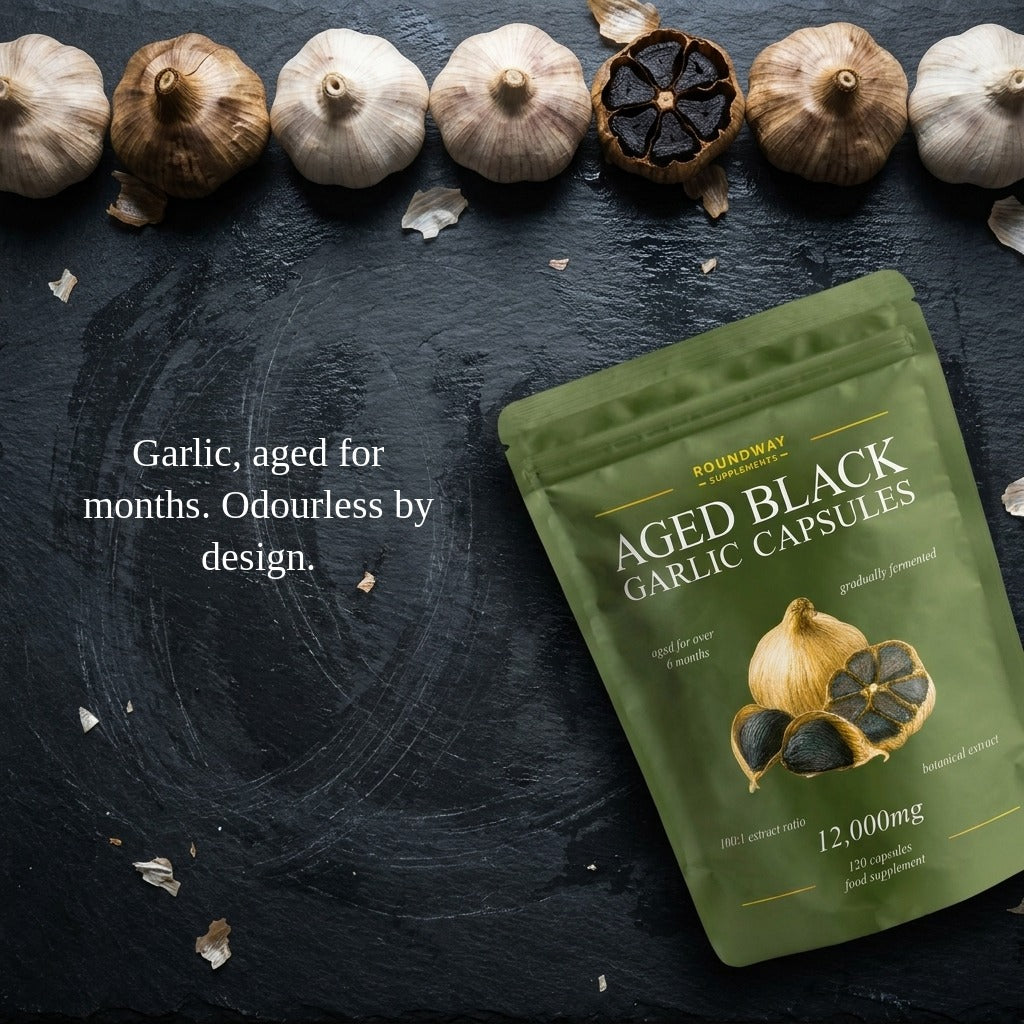
That is also why aged garlic capsules can be odourless. Whether a product says 'odourless' is worth checking on the label, because garlic powder and steam-distilled garlic oil keep more of the familiar smell.
One capsule of Aged Black Garlic, in three numbers
Aged black garlic extract in each capsule: the weight you actually take
The extract ratio, so each capsule is equivalent to 12,000mg of aged garlic
120 capsules at one a day, so the cost per day is the price divided by 120
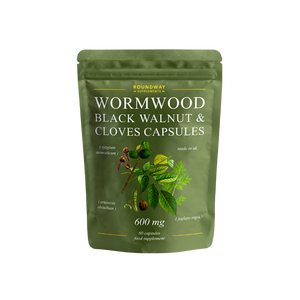
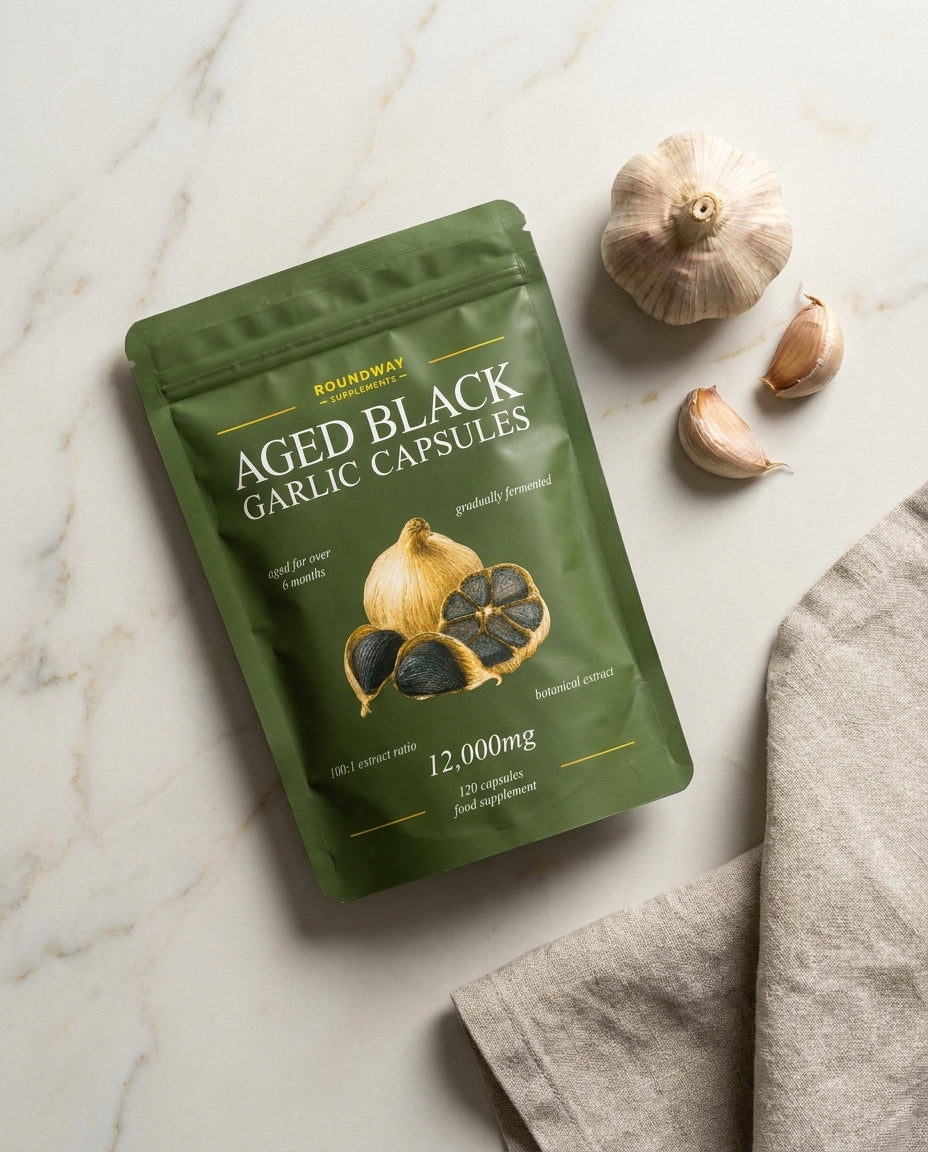
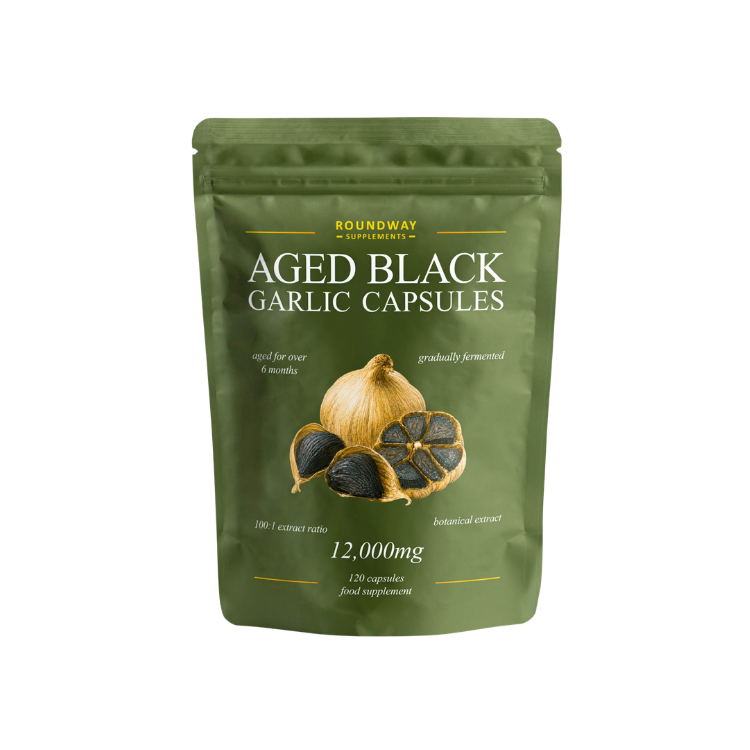
Pack label, Roundway Aged Black Garlic Extract capsules.
Aged Garlic Extract Capsules
120mg aged black garlic extract at 100:1, equivalent to 12,000mg of aged garlic, in each capsule. One capsule a day. 120 capsules. Odourless.
Questions
What is the difference between aged garlic and black garlic?
What does 100:1 mean on a garlic supplement?
Does 'equivalent to 12,000mg' mean there is 12,000mg of garlic in the capsule?
Is garlic oil the same as aged garlic extract?
Why doesn't aged garlic smell like fresh garlic?
How do I work out the cost per day of a garlic supplement?
The Food Supplements (England) Regulations 2003 (SI 2003/1387), regulation 6: labelling.
Elosta A, Slevin M, Rahman K, Ahmed N. Aged garlic has more potent antiglycation and antioxidant properties compared to fresh garlic extract in vitro. Scientific Reports, 2017; 7: 39613.
Kodera Y, Kurita M, Nakamoto M, Matsutomo T. Chemistry of aged garlic: diversity of constituents in aged garlic extract and their production mechanisms via the combination of chemical and enzymatic reactions. Experimental and Therapeutic Medicine, 2020; 19(2): 1574–1584.
Kimura S, Tung YC, Pan MH, Su NW, Lai YJ, Cheng KC. Black garlic: a critical review of its production, bioactivity, and application. Journal of Food and Drug Analysis, 2017; 25(1): 62–70.
Food supplements should not be used as a substitute for a varied diet and a healthy lifestyle.