



Soy germ extract and isoflavones, explained
Soy germ extract, sometimes labelled soybean germ extract, comes from the tiny shoot inside each soybean. Here is what that germ is, what soy isoflavones are, what "standardised to 40% isoflavones" means on a label, and how much soya foods contain.
- Soy germ extract is made from the germ, or hypocotyl, of the soybean: the small embryo shoot that sits between the two halves of each bean.
- The germ holds a far higher concentration of soy isoflavones than the rest of the bean. One analysis measured about 5.9mg per gram in the germ against about 0.4mg per gram in the cotyledons.
- Soy isoflavones are a family of plant compounds. The three main ones are genistein, daidzein and glycitein.
- Standardised to 40% isoflavones means 40% of the extract's weight is isoflavones, so 90mg of soy germ extract provides 36mg of isoflavones.
- Average isoflavone intake in a large UK study was under 1mg a day. A 100g serving of firm tofu contains around 30mg.
The smallest part of the bean
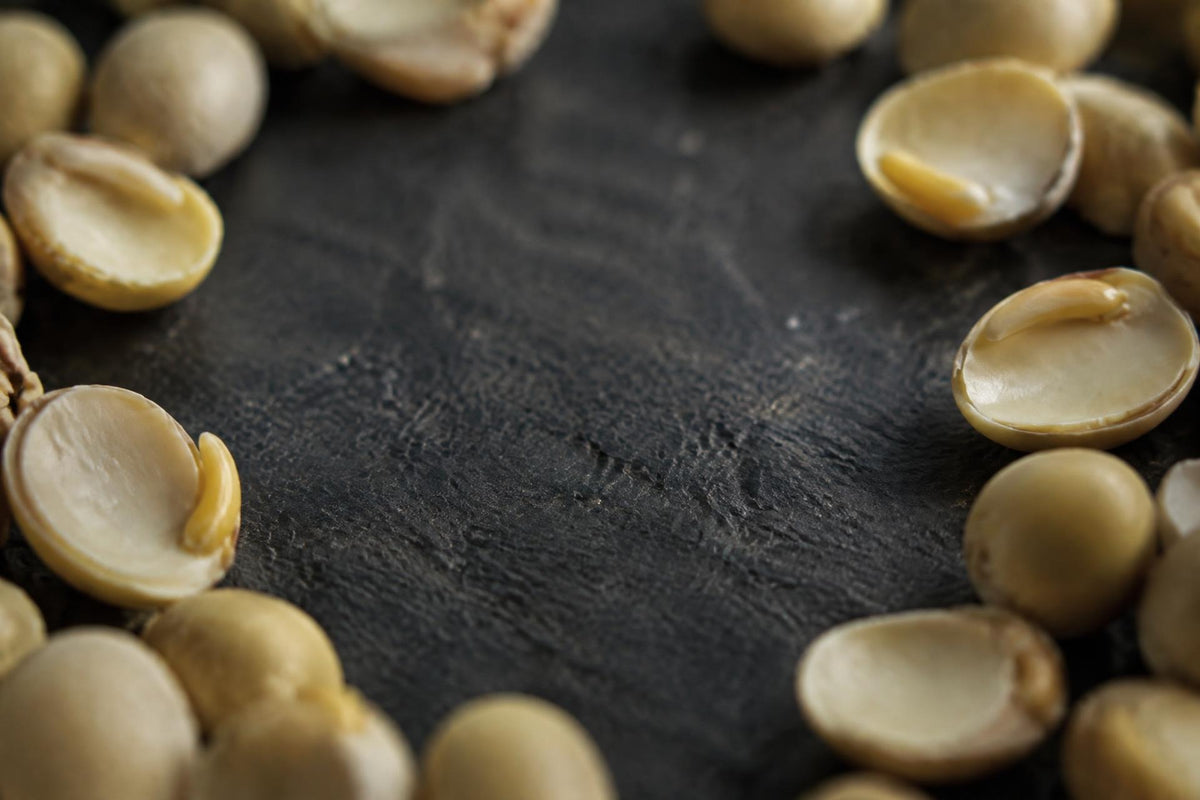
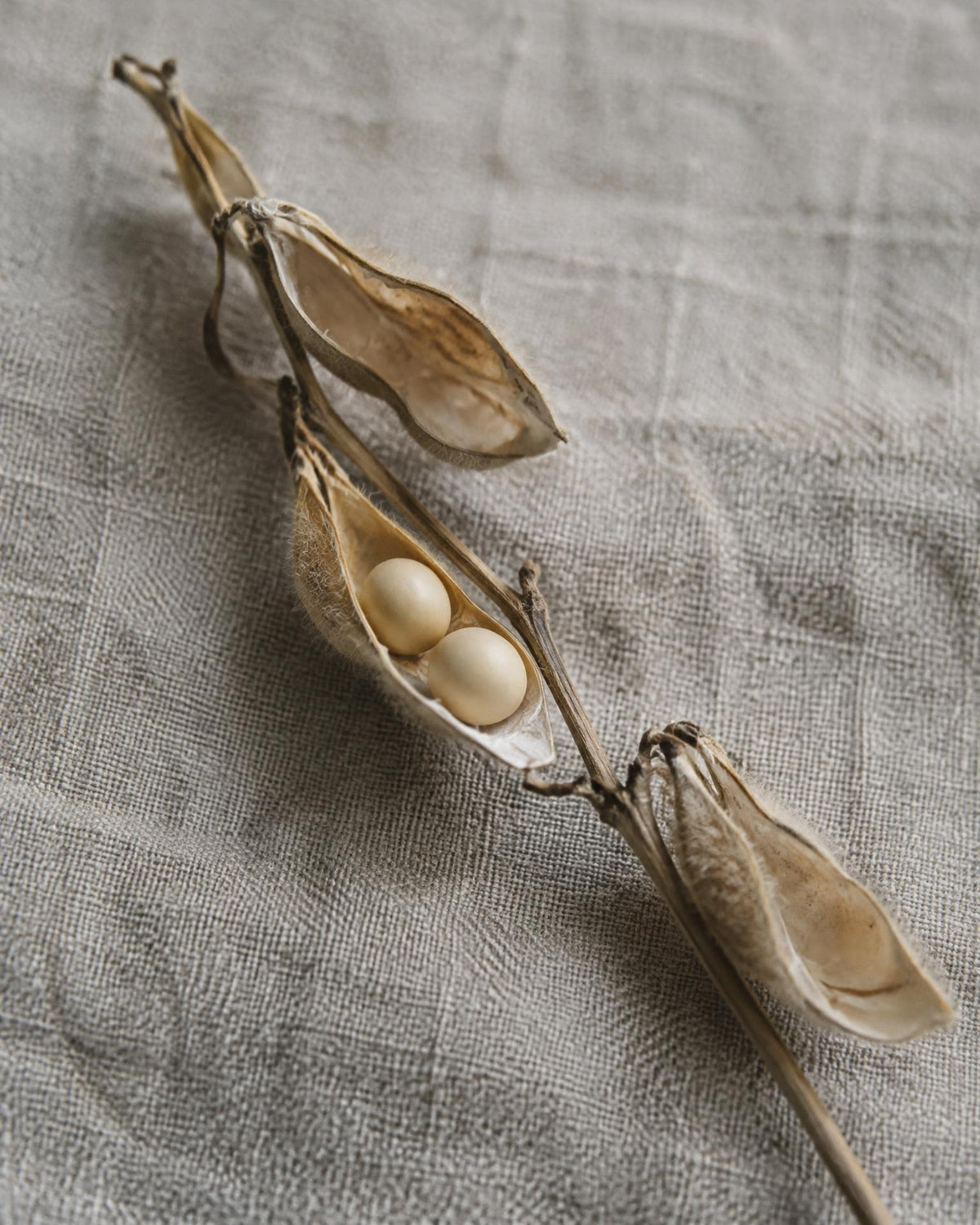
Split a dried soybean and most of what you see is two pale, fleshy halves. These are the cotyledons, the seed's food store. Tucked between them at one edge is a tiny curved shoot: the germ, which botanists call the hypocotyl. If the bean were planted, this is the part that would grow into the stem and root of a new seedling.
The germ is a small part of each bean, but it is where soy isoflavones are most concentrated. That is why it is separated out and made into soy germ extract, the ingredient you will also see written as soybean germ extract.
This piece explains what the germ is, what the isoflavones in it are, how to read the numbers on a label, and how they compare with everyday soya foods.
A small shoot with big numbers
Milligrams of isoflavones per gram in soybean germ against the cotyledons, in one Brazilian analysis
Isoflavones in 90mg of soy germ extract standardised to 40%
Average daily isoflavone intake among 11,843 adults in the EPIC-Norfolk study
Aguiar et al., 2007; Mulligan et al., EPIC-Norfolk, 2007.
From bean to germ to label
Three ideas that make soy germ extract easier to understand: where the germ sits, the forms isoflavones take, and what a standardised figure means.
Small part, high concentration.
How it worksA soybean is a seed coat wrapped around two cotyledons and a small embryo shoot, the hypocotyl. Japanese researchers found that 80 to 90% of a bean's isoflavones sit in the cotyledons, because the cotyledons make up most of the bean. Gram for gram, though, the germ is far richer.
The everyday contextSeparating the germ gives a starting material with a much higher isoflavone concentration than whole soya beans.
One isoflavone, four forms.
How it worksIn the bean, most isoflavones carry a sugar, and many also carry a malonyl group. Heat strips the malonyl group or turns it into an acetyl group, leaving a glucoside. Enzymes and fermentation can then remove the sugar, leaving the free form, called the aglycone.
The everyday contextThe USDA isoflavone database converts every form to aglycone values, so different foods can be compared fairly.
A percentage you can check.
How it worksA standardised extract is tested and adjusted so that a set share of its weight is the compound of interest. At 40%, every 100mg of extract carries 40mg of isoflavones. So 90mg of soy germ extract provides 36mg, and the other 54mg is the rest of the germ material.
The everyday context90mg soybean germ extract per two capsules, standardised to 40% isoflavones (36mg).
Three soy isoflavones, one family
Genistein
Usually the largest share in soya beans and most soya foods. In the bean it is mostly bound to a sugar as genistin and malonylgenistin.
USDA Isoflavone Database, Release 2.1Daidzein
Usually the second-largest share in soya beans, tofu and soya milk. In cooked edamame it runs roughly level with genistein.
USDA Isoflavone Database, Release 2.1Glycitein
A small share of the whole bean, but concentrated in the germ. In one collection of Japanese soybeans, glycitein forms averaged about a third of the germ's isoflavones.
Watanabe et al., Breeding Science, 2019Same three isoflavones, different balance
How the total divides between the three isoflavones. Switch between whole soya beans, the germ and soya milk.
In raw mature soya beans, genistein leads and glycitein is about a tenth of the total.
USDA Isoflavone Database, Release 2.1, 2015 (aglycone values, rounded); Watanabe et al., Breeding Science, 2019 (germ, mini-core average).
Working out the isoflavones in three steps
Find the extract amount
Look for the weight of soy germ extract per serving. On our label it is 90mg per two capsules.
Find the standardisation
Look for a line such as "standardised to 40% isoflavones". Without it, the extract amount tells you nothing about the isoflavone content.
Multiply
90mg × 40% = 36mg of isoflavones. Most labels show this figure in brackets, so you can check the maths.
How much is in everyday soya foods
Average total isoflavones per 100g, as aglycone values. Amounts vary widely between brands and batches. For a sense of scale, a 250ml glass of soya milk works out at roughly 27mg, and an 80g portion of cooked edamame at roughly 14mg.
USDA Database for the Isoflavone Content of Selected Foods, Release 2.1, 2015. Mean values, mg per 100g edible portion.
What a typical diet provides
In the UK, soya is a small part of most diets. The EPIC-Norfolk study followed 11,843 adults using seven-day food diaries and found an average isoflavone intake of under 1mg a day. Among people who ate soya foods, the average rose to 8.6mg for women and 7.5mg for men. The authors noted this may be an underestimate, because soya is added to many processed foods.
Intakes are much higher where soya is a staple. A review of dietary surveys estimated that older adults in Japan eat about 25 to 50mg of isoflavones a day, and that no more than 10% of people in Asia reach 100mg.
A single serving of firm tofu, at around 30mg per 100g, sits in that same range. The 36mg in a 90mg serving of 40% soy germ extract is a similar order of size, though labels and food databases may not measure isoflavones in exactly the same way.
How the germ came into focus
Soya beans have been eaten across East Asia for many centuries, as tofu, soya milk, miso, tempeh and edamame. Interest in the germ is far more recent and came from the laboratory rather than the kitchen.
In 1991, researchers in Japan isolated nine isoflavone glycosides from soybean hypocotyls, including three malonyl forms that turned out to be the main isoflavones in the raw seed. Four years later, another Japanese team showed that the germ held a much higher concentration of isoflavones than the cotyledons. In 1999, the US Department of Agriculture published the first edition of its isoflavone database, now a widely used reference for soya foods.
What EFSA's 2015 review looked at
In 2015 the European Food Safety Authority published a risk assessment of food supplements containing isolated isoflavones, for peri- and post-menopausal women. Its scientists looked at three organs: the breast, the uterus and the thyroid.
EFSA concluded that the evidence did not suggest harmful effects on those three organs in post-menopausal women, at the doses typically found in such supplements in the EU, reported as roughly 35 to 150mg a day. It said this was limited to the doses and durations studied, which for products on the EU market ranged from three months to just under a year.
EFSA also tried to assess women in the transition to menopause, and menopausal women with a personal or family history of cancer, but found no data to assess safety for these groups. Possible benefits were outside the scope of the review.

Pumpkin Seed and Soy Germ Capsules
Per two capsules: 600mg pumpkin seed extract 20:1 and 90mg soybean germ extract standardised to 40% isoflavones (36mg). 60 capsules. Contains soy.
Questions
What is soy germ extract?
What are soy isoflavones?
What does standardised to 40% isoflavones mean?
What is in a pumpkin seed and soy germ extract supplement?
How many isoflavones are in tofu and soya milk?
Aguiar CL, Baptista AS, Alencar SM, Haddad R, Eberlin MN. Analysis of isoflavonoids from leguminous plant extracts by RPHPLC/DAD and electrospray ionization mass spectrometry. International Journal of Food Sciences and Nutrition, 2007;58(2):116–124.
Tsukamoto C et al. Factors affecting isoflavone content in soybean seeds: changes in isoflavones, saponins, and composition of fatty acids at different temperatures during seed development. Journal of Agricultural and Food Chemistry, 1995;43(5):1184–1192.
Kudou S et al. Malonyl isoflavone glycosides in soybean seeds (Glycine max Merrill). Agricultural and Biological Chemistry, 1991;55(9):2227–2233.
Watanabe S, Yamada R, Kanetake H, Kaga A, Anai T. Identification and characterization of a major QTL underlying soybean isoflavone malonylglycitin content. Breeding Science, 2019;69(4):564–572.
Bhagwat S, Haytowitz DB. USDA Database for the Isoflavone Content of Selected Foods, Release 2.1. US Department of Agriculture, 2015.
Mulligan AA, Welch AA, McTaggart AA, Bhaniani A, Bingham SA. Intakes and sources of soya foods and isoflavones in a UK population cohort study (EPIC-Norfolk). European Journal of Clinical Nutrition, 2007;61(2):248–254.
Messina M, Nagata C, Wu AH. Estimated Asian adult soy protein and isoflavone intakes. Nutrition and Cancer, 2006;55(1):1–12.
EFSA Panel on Food Additives and Nutrient Sources added to Food. Risk assessment for peri- and post-menopausal women taking food supplements containing isolated isoflavones. EFSA Journal, 2015;13(10):4246.
European Food Safety Authority. Isoflavones in food supplements for post-menopausal women: no evidence of harm. News release, 21 October 2015.
NutraIngredients. Report on EFSA's 2015 isoflavones opinion, including typical supplement doses of 35–150mg a day.
Food supplements should not be used as a substitute for a varied diet and a healthy lifestyle.