



Lactobacillus reuteri, explained
Lactobacillus reuteri, now also called Limosilactobacillus reuteri, is a lactic acid bacterium found in people, animals and even sourdough. Here is what L. reuteri is, how its name changed, what CFU and strain codes mean on a label, and what researchers are studying.
- Lactobacillus reuteri (L. reuteri) is a lactic acid bacterium named after the German microbiologist Gerhard Reuter and described as a species by Otto Kandler and colleagues in 1980.
- In 2020 the Lactobacillus genus was split into 25 genera, and L. reuteri was renamed Limosilactobacillus reuteri. It is the same bacterium under a new genus name.
- L. reuteri lives naturally in the gut of humans and many animals, has been found in the breast milk of about one in seven women studied, and occurs in some sourdoughs.
- On an L. reuteri supplement, CFU (colony forming units) counts the live cultures that can grow, and a strain code names the exact culture used.
- Researchers are studying how different L. reuteri strains behave, and results from one strain are not assumed to apply to another.
A bacterium with a long paper trail
Lactic acid bacteria are the family behind yoghurt, sauerkraut and sourdough. They turn sugars into lactic acid, and they have been studied for more than a century.
L. reuteri sat in that family for decades before it had its own name. Early researchers grouped it with Lactobacillus fermentum. In the 1960s Gerhard Reuter set it apart as a separate biotype, and in 1980 Otto Kandler and colleagues described it as a species in its own right, naming it after him.
One bacterium, two names
The year Kandler and colleagues described Lactobacillus reuteri as a distinct species
Species in the old Lactobacillus genus by March 2020, before it was reorganised
Genera the group was divided into in 2020, one of them Limosilactobacillus
Kandler, Stetter and Köhl, 1980; Zheng et al., International Journal of Systematic and Evolutionary Microbiology, 2020.
A new name, a count and a fibre
Three ideas that make an L. reuteri label easier to read. This is how the science and the counting work, not a promise of results.
Why it is now Limosilactobacillus.
How it worksBy 2020 the Lactobacillus genus held 261 species, too many and too varied to sit in one group. Comparing whole genomes, Zheng and colleagues split it into 25 genera. L. reuteri moved to Limosilactobacillus. The species name stayed, so it is still L. reuteri.
The everyday contextBoth names describe the same bacterium. Older papers and labels use Lactobacillus; newer ones use Limosilactobacillus.
What CFU actually counts.
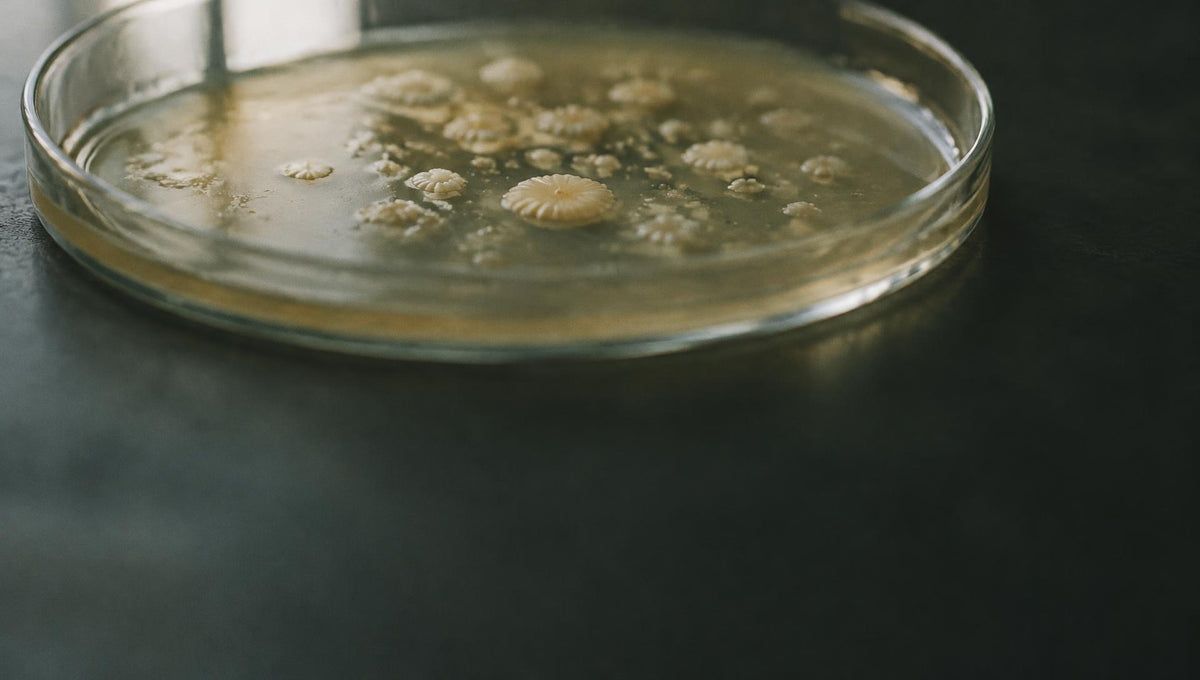
How it worksCFU stands for colony forming units. A sample is diluted step by step, spread on a nutrient gel called agar and kept warm. Each living cell, or small clump of cells, grows into a visible colony. Counting the colonies and multiplying back by the dilution gives the CFU.
The everyday context10 billion CFU is 10,000,000,000, sometimes written 1 × 10¹⁰. Only cells that can grow are counted.
A fibre from chicory root.
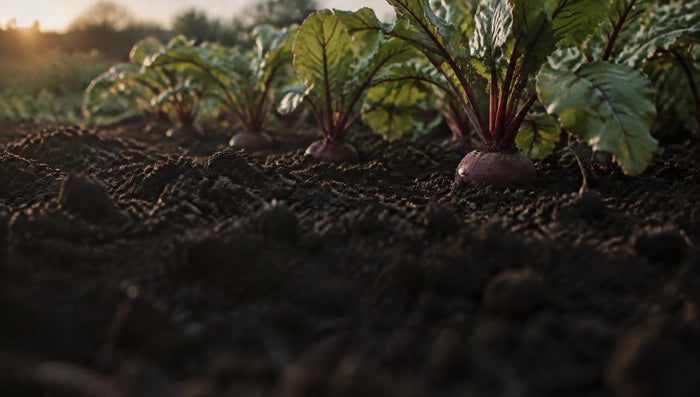
How it worksInulin is a chain of fructose units, from 2 to around 60 long in chicory. Our own enzymes can't break those links, so inulin passes through the small intestine intact and reaches the large intestine, where bacteria ferment it.
The everyday contextInulin is a fibre that lactic acid bacteria and other gut bacteria can ferment, which is why it is often paired with live cultures.
Three places L. reuteri turns up naturally
L. reuteri has been isolated from many vertebrates. Strains from different hosts form separate family lines, and sourdough strains trace back to the gut.
About one in seven women had L. reuteri in their breast milk, across samples from seven countries on different continents. Source: Sinkiewicz, Malmö University, 2010; Sinkiewicz and Ljunggren, Microbial Ecology in Health and Disease, 2009.
What a strain code tells you
Genus
The wider group: Limosilactobacillus, or Lactobacillus on older labels. Often shortened to L.
Zheng et al., 2020Species
reuteri. Every L. reuteri shares this name, wherever it was found.
Kandler et al., 1980Strain code
Letters and numbers after the species name identify one particular culture, isolated from one source. Two strains of the same species can behave differently.
Culture collection
The letters often show where a strain is deposited. The reference culture for the species is held as DSM 20016 in Germany and ATCC 23272 in the United States.
LPSN, DSMZ
Libraries of living cultures
When a new strain is described, a sample is deposited in a public culture collection, such as the DSMZ in Braunschweig, Germany, or the ATCC in Virginia, USA. There it is kept frozen or freeze-dried, so researchers anywhere can order the same culture and repeat the work.
That is why the strain code matters more than the species name when you read a study. A paper on one L. reuteri strain is a paper on that strain, not on every L. reuteri.
What researchers are studying
How it settled in different hosts
Strains taken from humans, mice, rats, pigs, chickens and turkeys fall into separate family lines that follow their host. Researchers study this as an example of a bacterium adapting to the animal it lives in.
Strain by strain
Human studies test named strains, often in small groups over weeks or months. Their findings belong to the strain tested, which is why papers always give the code.
From lab to people
Much of the work starts in the lab or in animals. These studies show researchers where to look next; they don't tell us what happens in people.
Where 225mg of inulin sits in a day
Inulin is a fibre, but the amount in a capsule is small next to the fibre in a day's food. A varied, plant-rich diet is still where most fibre comes from.
NHS, How to get more fibre into your diet; pack label.

Lactobacillus Reuteri Capsules
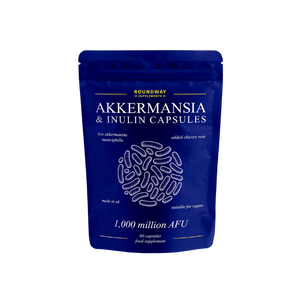
Lactobacillus reuteri, 10 billion CFU, with 225mg of inulin from chicory root, per capsule. One capsule a day. 60 vegan capsules.
Questions
What is Lactobacillus reuteri?
Is L. reuteri the same as Limosilactobacillus reuteri?
What does CFU mean on an L. reuteri supplement?
Where is L. reuteri found naturally?
Can you buy Lactobacillus reuteri in the UK?
Kandler O, Stetter KO, Köhl R. Lactobacillus reuteri sp. nov., a new species of heterofermentative lactobacilli. Zentralblatt für Bakteriologie, Mikrobiologie und Hygiene, 1980.
Zheng J, Wittouck S, Salvetti E, et al. A taxonomic note on the genus Lactobacillus: description of 23 novel genera, emended description of the genus Lactobacillus Beijerinck 1901, and union of Lactobacillaceae and Leuconostocaceae. International Journal of Systematic and Evolutionary Microbiology, 2020;70:2782–2858.
LPSN, List of Prokaryotic names with Standing in Nomenclature. Limosilactobacillus reuteri. DSMZ.
Frese SA, Benson AK, Tannock GW, et al. The evolution of host specialization in the vertebrate gut symbiont Lactobacillus reuteri. PLoS Genetics, 2011.
Sinkiewicz G, Ljunggren L. Occurrence of Lactobacillus reuteri in human breast milk. Microbial Ecology in Health and Disease, 2009. Summarised in Malmö University, ScienceDaily, 2010.
Su MS, Oh PL, Walter J, Gänzle MG. Intestinal origin of sourdough Lactobacillus reuteri isolates as revealed by phylogenetic, genetic, and physiological analysis. Applied and Environmental Microbiology, 2012.
Roberfroid MB. Inulin-type fructans: functional food ingredients. Journal of Nutrition, 2007.
NHS. How to get more fibre into your diet. nhs.uk.
Food supplements should not be used as a substitute for a varied diet and a healthy lifestyle.