



Ethiopian black seed oil, explained
Black seed oil is pressed from the small, matte-black seeds of Nigella sativa. Here is why Ethiopia matters, what cold-pressed and unfiltered mean, what thymoquinone is, and how to read a black seed oil label.
- Ethiopian black seed oil is oil pressed from the seeds of Nigella sativa grown in Ethiopia, a plant also known as black cumin, kalonji and habbatul barakah.
- Black cumin is one of Ethiopia's main export spices, second only to ginger, and is grown widely in highland areas such as Bale in the south-east.
- Cold-pressed black seed oil is pressed mechanically without added heat, and unfiltered oil keeps the fine seed sediment that filtering would remove.
- Thymoquinone is a natural compound in black seed, and an oil standardised to 5% thymoquinone holds 50mg in every gram, so 800mg of oil gives 40mg.
- To compare black seed oil softgels or capsules, check the oil per serving, the thymoquinone percentage, how the oil was pressed and what the shell is made of.
Four names you will see on a label
Nigella sativa
The botanical name. A small annual in the buttercup family, Ranunculaceae, with pale blue-white flowers and an inflated seed capsule.
Matthaus and Özcan, 2011Black cumin
The common English name, though it is no relation of the cumin in your spice rack, which comes from Cuminum cyminum in the carrot family.
Kalonji
The name used across India, Pakistan and Bangladesh, and a common name on jars of the whole seeds sold in the UK.
Habbatul barakah
Arabic for 'the seed of blessing', a name that reflects how long the seed has been valued across the Middle East and North Africa.
Ahmad et al., 2013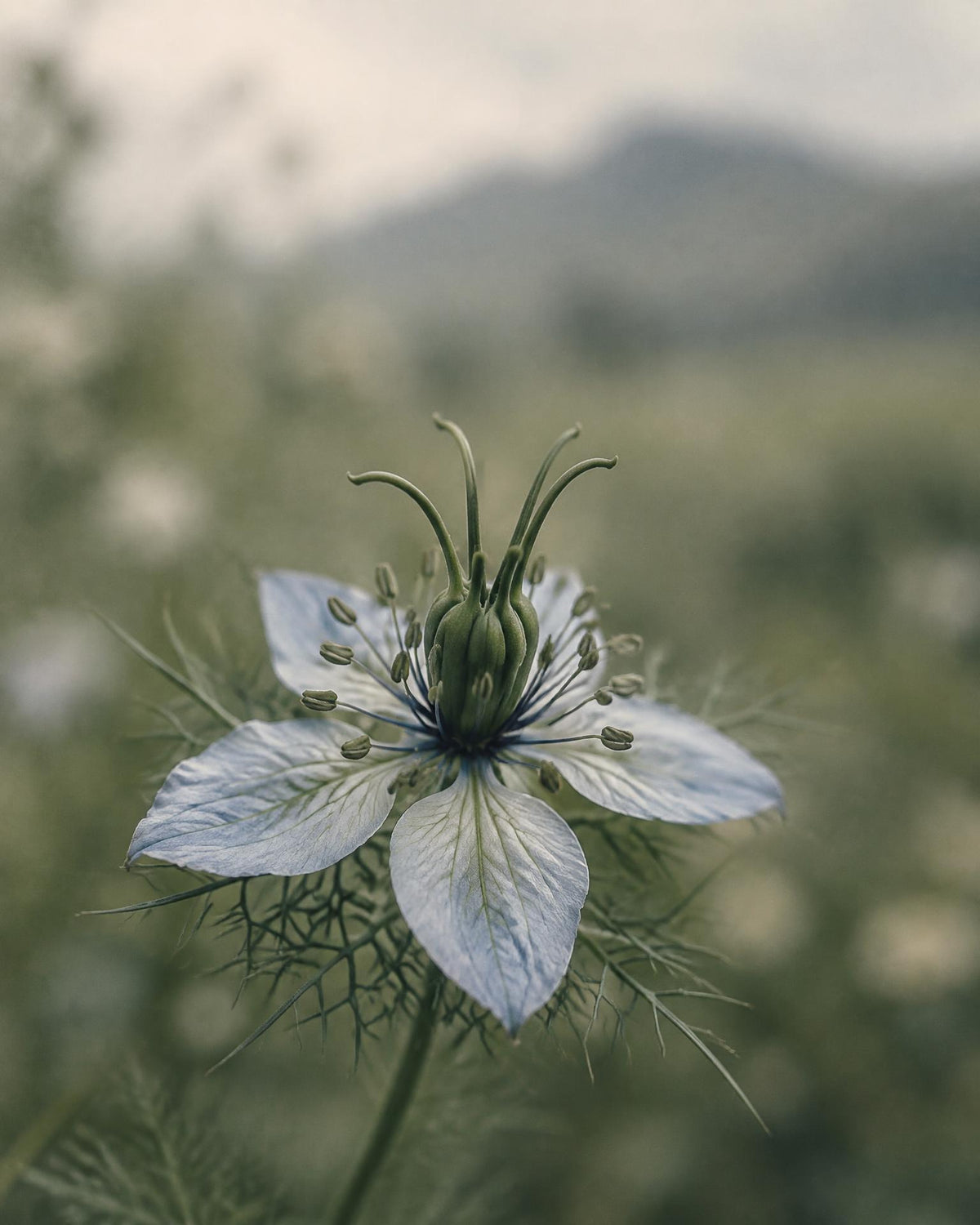
A highland crop with a long export trade
Ethiopia's range of altitudes and climates suits many spices, and black cumin is one of the most important. Among spices, it is the country's second-most exported crop after ginger, and a valued source of income for smallholder farmers.
Much of it grows in the highlands and mid altitudes of Bale, in south-eastern Ethiopia, where research stations sit between roughly 1,650m and 2,400m above sea level. It is usually grown as a seasonal field crop by small farms rather than on large estates.
So 'Ethiopian' on a label tells you where the seed was grown. It doesn't, on its own, tell you how the oil was pressed or how much thymoquinone it holds. Those details sit elsewhere on the label.
What black seed oil is made of
Tap through: from the whole seed, to its oil, to the one compound labels are standardised to.
In one analysis of 13 Nigella sativa samples, oil made up between about 30% and 36% of the seed's weight.
Matthaus and Özcan, Czech Journal of Food Sciences, 2011 (approximate shares, rounded). 5% is a label standardisation.
From seed to softgel, step by step
Three things that decide what ends up in a black seed oil.
About a third of the seed is oil.
How it worksBlack seeds are small, but oil-rich. The oil can be pressed out mechanically, or extracted with solvents and then refined. The method shapes the colour, the aroma and what else comes with the oil.
The everyday contextLook for the amount of oil per serving, in milligrams, and the word that describes how it was made.
No added heat. Nothing stripped out.
How it worksUnder the international Codex standard, cold-pressed oils are obtained by mechanical means only, such as pressing, without the application of heat. Refined oils go through extra steps designed to remove colour, flavour and aroma. Unfiltered oil skips filtering too, so it keeps fine seed sediment and can look cloudy.
The everyday context'Cold-pressed' describes the method. 'Unfiltered' means the oil was left as it came from the press.
One compound, a small share.
How it worksThymoquinone is a natural compound in black seed and the main component of its volatile, aromatic oil. It is the compound most researchers measure. Laboratory work has found it breaks down quickly when exposed to light, which is one reason oils are often sold in dark bottles or sealed softgels.
The everyday context'Standardised to 5% thymoquinone' means the oil is tested so that 5% of its weight is thymoquinone.
Same name, very different oils
The lowest thymoquinone content measured in ten commercial black seed oils
The highest thymoquinone content measured in the same ten products
Roughly how much more the highest product contained than the lowest
Alkhatib et al., Journal of Pharmacy and Bioallied Sciences, 2020 (HPLC analysis of products on sale in Malaysia).
What '5% thymoquinone' means in milligrams
The same 800mg of oil, standardised to different levels. The milligrams of thymoquinone are simply the oil multiplied by the percentage.
Worked examples. A label that gives no thymoquinone figure gives you nothing to multiply.
How to compare black seed oils on a label
Find the oil per serving
Look for milligrams of oil per serving, and check how many softgels or capsules make up that serving. A pack of 60 at two a day lasts 30 days.
Turn the percentage into milligrams
If the oil is standardised, multiply the oil by the thymoquinone percentage. If there is no figure, there is nothing to compare.
Check the method and the shell
Look for 'cold-pressed' and whether it is filtered, the country of origin, and the shell. Many softgels use bovine gelatin, which isn't suitable for vegetarians or vegans.
From a pharaoh's tomb to a naan
Black seed has a long history. Seeds identified as Nigella sativa have been reported from several ancient Egyptian sites, including the tomb of Tutankhamun, though archaeobotanists describe the wider record of its early cultivation as scanty. Why the seeds were placed there isn't known.
In the kitchen, it is far more familiar. Kalonji seeds are scattered over naan before baking, where they toast to a faintly bitter, oniony crunch. In Bengali cooking, nigella is one of the five whole spices in panch phoron, alongside fenugreek, cumin, mustard and fennel, which are fried briefly in hot oil at the start of a dish.
What researchers are studying
Nigella sativa is one of the more widely studied culinary seeds, and most of that work centres on thymoquinone. Much of it is laboratory chemistry: how much thymoquinone different oils contain, how extraction and pressing change it, and how stable it is in light, heat and water.
Human studies exist, but they tend to be small and short, and they use different doses and oils of different quality, which makes them hard to compare. For now, researchers are still describing what black seed oil contains and how it behaves, and the evidence is best read as early.
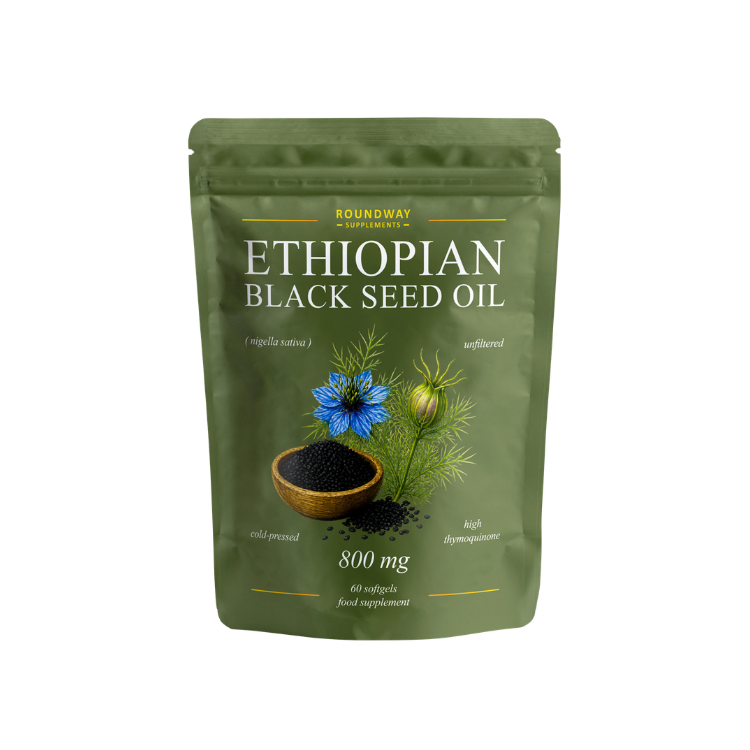
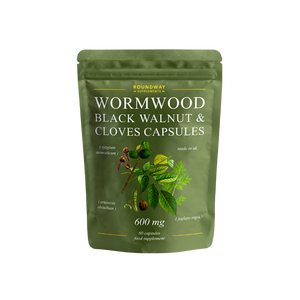
Ethiopian Black Seed Oil
800mg cold-pressed, unfiltered Ethiopian black seed oil (Nigella sativa) per two softgels, standardised to 5% thymoquinone (40mg). 60 softgels, 30 days. Bovine gelatin softgel, so not suitable for vegetarians or vegans.
Questions
What is Ethiopian black seed oil?
What is thymoquinone in black seed oil?
What does 'standardised to 5% thymoquinone' mean?
What is the difference between cold pressed and refined black seed oil?
Are black seed oil softgels and capsules in the UK vegetarian?
Gutema C. Effects of N and NPS fertilizer on yield components and seed yield of black cumin (Nigella sativa L.) at Bale, south-eastern Ethiopia. International Journal of Seed Spices, 2024; 14(1): 47–56.
Matthaus B, Özcan MM. Fatty acids, tocopherol, and sterol contents of some Nigella species seed oil. Czech Journal of Food Sciences, 2011; 29: 145–150.
Alkhatib H, Mawazi SM, Al-Mahmood SMA, Zaiter A, Doolaanea AA. Thymoquinone content in marketed black seed oil in Malaysia. Journal of Pharmacy and Bioallied Sciences, 2020; 12(3): 284–288.
Salmani JMM, Asghar S, Lv H, Zhou J. Aqueous solubility and degradation kinetics of the phytochemical thymoquinone; probing the effects of solvents, pH and light. Molecules, 2014; 19(5): 5925–5939.
Ahmad A, Husain A, Mujeeb M, et al. A review on therapeutic potential of Nigella sativa. Asian Pacific Journal of Tropical Biomedicine, 2013; 3(5): 337–352.
Codex Alimentarius. Standard for Named Vegetable Oils (CXS 210-1999), section 2: definitions of virgin and cold pressed oils.
Zohary D, Hopf M, Weiss E. Domestication of Plants in the Old World, 4th edition. Oxford University Press, 2012.
Food supplements should not be used as a substitute for a varied diet and a healthy lifestyle.